
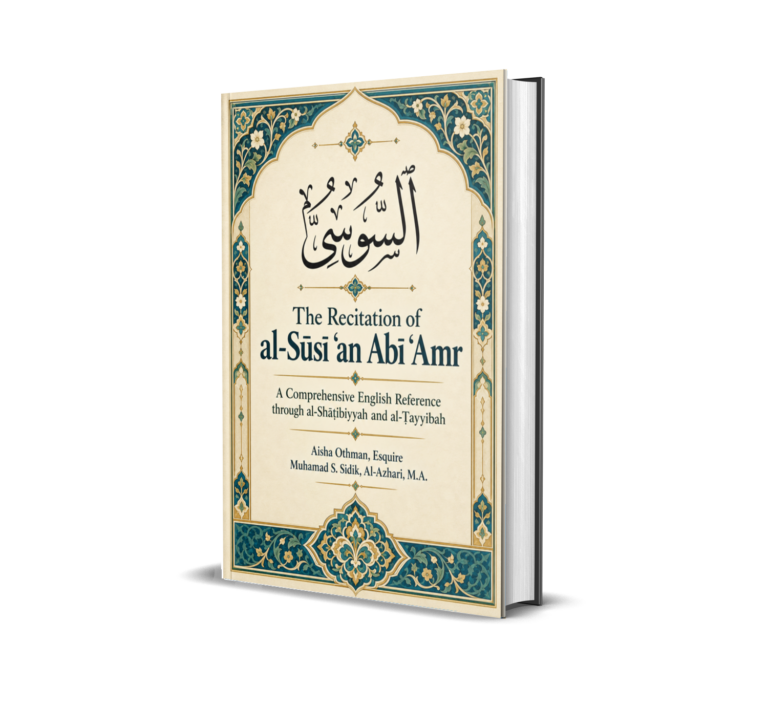
Study the recitation of al-Sūsī through its principles, transmission paths, and Qur’anic examples.
The Recitation of al-Sūsī ʿan Abī ʿAmr is an English reference to the riwāyah of al-Sūsī from Imām Abū ʿAmr al-Baṣrī. Designed for students and teachers of the Qur’anic recitations, it provides a structured way to study the general rules of this transmission and locate its particular readings throughout the Qur’an.
Drawing on the work of Tawfīq Ibrāhīm Ḍamrah, the book brings together uṣūl, the general principles of recitation, and farsh al-ḥurūf, the readings associated with particular words and passages. English explanations accompany Arabic examples, helping readers connect each instruction to the form being recited.
Inside this volume, readers will find:
- Foundations and transmission: Introductions to Imām Abū ʿAmr and al-Sūsī, essential terminology, and the importance of following a consistent transmission path.
- Detailed explanations of the general rules: Vowel lengthening, single and paired hamzahs, great and small assimilation, imālah and taqlīl, pronouns, yāʾ forms, and stopping.
- All 114 sūrahs within one Farsh al-Ḥurūf chapter: Individual sūrah subsections make the material easy to follow in Qur’anic order and consult during lessons.
- Arabic comparisons with Ḥafṣ: Verse-referenced tables present the Arabic forms for Ḥafṣ and al-Sūsī alongside English instructions explaining how the relevant reading is performed.
- Discussion of al-Shāṭibiyyah and al-Ṭayyibah: Explanations of transmission paths, additional treatments, and the need to understand which choices belong to the route being studied.
- Resources for continued study: Review questions and an answer guide, a glossary of recitation terms, a sūrah locator, bibliography, and discussion of verse numbering and cross-referencing.
Particular attention is given to the circumstances in which a rule applies, including the distinction between continuing a recitation and stopping. This helps readers move from recognizing a written difference to understanding the instruction attached to it.
The organization supports both sustained study and quick consultation. Readers can work through the principles in sequence, revisit a specific topic, or turn directly to a sūrah and āyah for comparison and revision.
Designed to accompany oral instruction, The Recitation of al-Sūsī ʿan Abī ʿAmr offers students and teachers an organized reference to return to throughout their study of this riwāyah.